
Vietnam die casting for automotive lighting has become a strategic sourcing solution for global OEMs seeking precision, cost efficiency, and scalable production. As vehicle lighting systems evolve toward LED, adaptive, and smart technologies, component complexity increases significantly. Consequently, manufacturers must meet stricter dimensional tolerances, enhanced thermal performance, and superior surface finishing standards.
Vietnam’s modern foundries combine advanced Vietnam high pressure die casting (HPDC) capabilities with integrated secondary processes such as anodizing, CNC machining, and leak testing. Therefore, international buyers benefit from a vertically integrated production ecosystem designed specifically for automotive lighting components.
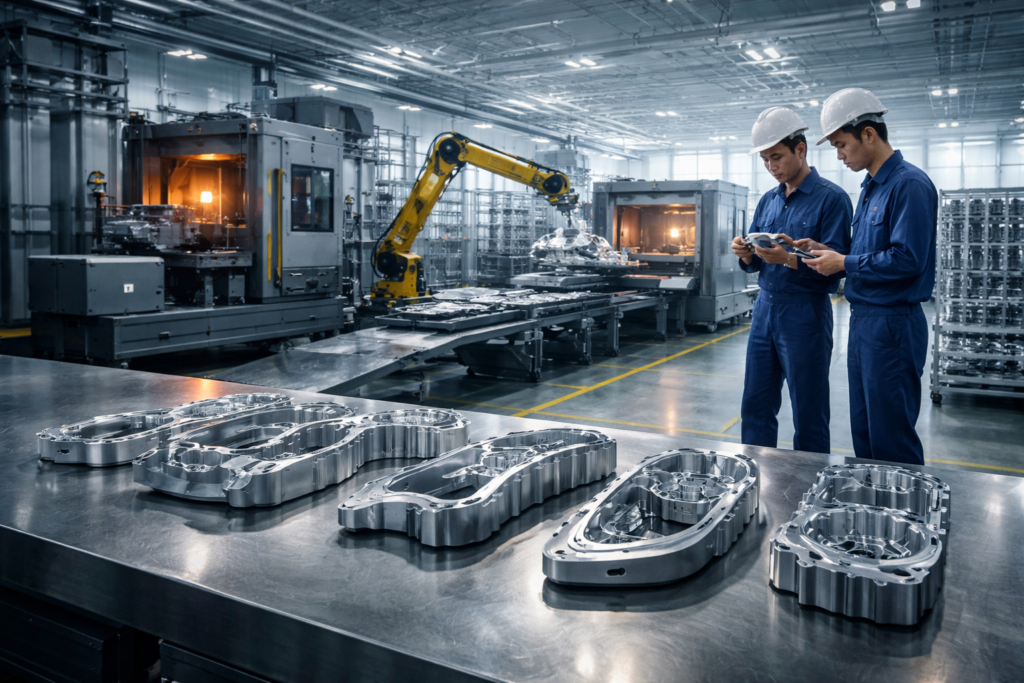
Precision Requirements in Automotive Lighting Casting
Automotive lighting components require high dimensional stability and structural integrity. Because headlamp housings, reflectors, and LED heat sinks operate under thermal stress, aluminum casting precision is critical.
Vietnam die casting for automotive lighting focuses on:
- High thermal conductivity aluminum alloys
- Thin-wall casting for lightweight designs
- Complex rib structures for heat dissipation
- Tight flatness tolerances
- Surface consistency for anodizing compatibility
Moreover, mold design optimization ensures minimal porosity and improved structural density. Through Vietnam high pressure die casting (HPDC), molten aluminum is injected at controlled pressure levels to achieve detailed geometries and smooth surface finishes.
As a result, manufacturers can deliver both aesthetic and functional performance required by global automotive brands.
To explore full capabilities and engineering expertise, visit our Vietnam Die Casting homepage.
Vietnam High Pressure Die Casting (HPDC) for Lighting Applications
Vietnam high pressure die casting (HPDC) is the preferred process for automotive lighting parts due to its repeatability and precision. This process enables high-volume production while maintaining consistent dimensional accuracy.
In automotive lighting production, HPDC supports:
-
LED heat sink housings
-
Headlamp brackets
- Reflector frames
- Rear lamp structural components
- Adaptive lighting modules
Because cycle times are short and tooling durability is high, HPDC ensures competitive cost per unit without compromising quality.
Additionally, simulation software is used during mold development to predict metal flow, cooling rates, and shrinkage patterns. Consequently, tooling revisions are minimized and time-to-market improves.
Surface Finishing and Anodizing Capabilities
Anodizing plays a critical role in automotive lighting applications. Not only does anodizing improve corrosion resistance, but it also enhances surface appearance and thermal emissivity.
Vietnam die casting for automotive lighting integrates anodizing lines capable of delivering:
- Uniform oxide layer thickness
Enhanced corrosion resistance
Improved electrical insulation
Aesthetic matte or satin finishes
Because anodizing requires consistent surface preparation, casting quality directly influences finishing results. Therefore, process control during HPDC production is essential.
Furthermore, CNC machining after casting ensures dimensional precision before anodizing begins. This integration strengthens final component reliability.
Quality Control Standards for Automotive Lighting
Global automotive brands require strict compliance with ISO and IATF quality systems. Vietnam die casting for automotive lighting facilities implement comprehensive inspection processes to ensure consistent output.
Quality control measures typically include:
- Coordinate Measuring Machine (CMM) validation
X-ray inspection for internal porosity
Surface roughness measurement
Thermal performance testing
Salt spray corrosion testing
Through these structured procedures, manufacturers can provide full traceability documentation. Consequently, buyers gain confidence in long-term supply stability.
Moreover, digital manufacturing integration allows real-time process monitoring. Defect trends can be analyzed and corrected promptly, reducing production variability.
Thermal Management and Lightweighting
Modern vehicle lighting systems rely heavily on LED technology. Because LEDs generate concentrated heat, effective thermal management becomes critical.
Vietnam die casting for automotive lighting supports lightweight aluminum designs with optimized heat dissipation channels. Thin-wall casting techniques reduce overall weight while maintaining mechanical strength.
In addition, aluminum alloys such as A380 and ADC12 provide strong thermal conductivity combined with structural integrity. Therefore, components remain durable under prolonged operating temperatures.
This balance between weight reduction and heat management supports electric vehicle development, where energy efficiency is increasingly important.
Cost Competitiveness and Supply Chain Stability
Vietnam offers competitive manufacturing costs compared to traditional sourcing markets. However, cost advantage alone does not define supplier capability.
Vietnam die casting for automotive lighting combines:
- Skilled engineering workforce
Stable aluminum supply chains
Advanced HPDC infrastructure
Integrated finishing capabilities
Flexible production scaling
Because production lines are export-oriented, logistics systems are optimized for global shipment. Furthermore, trade agreements enhance tariff advantages for overseas buyers.
These factors collectively position Vietnam as a reliable partner for automotive lighting casting programs.
Engineering Support and Customization
Automotive lighting programs often require customized tooling and engineering collaboration. Vietnam die casting for automotive lighting providers typically support:
- DFM analysis
Mold flow simulation
Rapid prototyping
Tooling fabrication
Pilot production runs
Early engineering involvement reduces design errors and accelerates project timelines. Consequently, OEMs can move from prototype validation to mass production efficiently.
Additionally, communication in English and technical documentation alignment facilitate smoother international collaboration.
Sustainability and Environmental Compliance
Sustainability is increasingly important within the automotive sector. Vietnam die casting facilities adopt energy-efficient furnaces and recycling systems to reduce environmental impact.
Recycled aluminum content, controlled emission systems, and wastewater treatment compliance contribute to environmentally responsible production.
Furthermore, anodizing processes are managed to meet environmental discharge regulations. Therefore, buyers seeking ESG-aligned suppliers can evaluate Vietnam as a responsible manufacturing base.
Why Choose Vietnam Die Casting for Automotive Lighting
Choosing Vietnam die casting for automotive lighting ensures:
- Precision high pressure die casting technology
Integrated anodizing and finishing
Advanced inspection and traceability
Competitive cost structure
Engineering collaboration and customization
Stable export-oriented logistics
Because automotive lighting components directly affect vehicle safety and aesthetics, supplier reliability is non-negotiable.
Vietnam’s combination of HPDC expertise, anodizing capability, and quality control infrastructure delivers performance aligned with international automotive standards.
Conclusion
Vietnam die casting for automotive lighting offers a complete manufacturing solution for OEMs seeking precision, durability, and cost efficiency. By leveraging Vietnam high pressure die casting (HPDC) and advanced anodizing processes, manufacturers deliver components that meet strict automotive performance requirements.
As vehicle lighting systems become more advanced, the demand for precise aluminum casting continues to grow. Partnering with experienced Vietnamese die casting providers ensures scalable production, consistent quality, and long-term supply stability.
If you are evaluating suppliers for automotive lighting casting programs, now is the time to explore Vietnam die casting for automotive lighting capabilities and secure a reliable production partner for your next project.