
Vietnam is entering a new industrial phase driven by Industry 4.0 technologies. Over the past decade, manufacturers have moved beyond cost-based competition and started investing in automation, connected systems, and intelligent quality monitoring. As a result, digital manufacturing has become a structural upgrade rather than a marketing label.
Previously, factories operated through semi-manual coordination between departments. Today, however, production lines increasingly rely on integrated data systems that synchronize casting, machining, inspection, and logistics. Consequently, manufacturers can reduce variability and increase throughput without sacrificing precision.
For global OEMs, this transformation directly impacts sourcing confidence. Instead of relying solely on manual inspection reports, buyers gain access to real-time production insights and traceability dashboards.
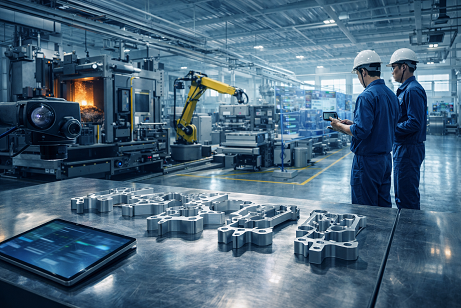
What Defines Digital Manufacturing in Vietnam?
In practical terms, digital manufacturing refers to the integration of smart production technologies into factory operations. More specifically, it connects machinery, engineers, and enterprise software into a unified data ecosystem.
Key components typically include:
• IoT-enabled die casting machines
• MES platforms linked to ERP systems
• Automated robotic handling
• AI quality control die casting Vietnam solutions
• Predictive maintenance software
• Digital twin mold simulations
Because machines continuously transmit performance data, plant managers can monitor pressure curves, melt temperatures, and cycle times in real time. Therefore, deviations are detected early rather than after batch completion.
This approach significantly lowers scrap rates while stabilizing dimensional accuracy.
AI Quality Control in Die Casting Vietnam
One of the most visible advancements in Industry 4.0 adoption is AI quality control die casting Vietnam integration. Traditionally, inspection relied on sampling methods and manual visual checks. Although effective to some extent, those methods introduce human inconsistency.
By contrast, AI in QC applies machine vision systems trained on thousands of defect patterns. These systems can instantly identify:
• Surface porosity
• Cold shuts
• Flash inconsistencies
• Micro-cracks
• Dimensional deviations
Moreover, inspection data is stored automatically, enabling traceability for ISO and IATF audits. As a result, quality verification becomes objective and scalable.
Because AI inspection operates continuously, consistency remains stable across shifts and production volumes. In addition, real-time alerts allow corrective action before defects multiply.
AI Die Casting Vietnam
For the Digital Manufacturing & Industry 4.0 Vertical, AI die casting Vietnam represents the integration of artificial intelligence, smart sensors, and data analytics into modern casting operations. These technologies enable predictive maintenance, real-time quality control, and optimized production efficiency for globally competitive manufacturing.
AI in QC Beyond Die Casting
Importantly, AI in QC is not limited to casting operations. In CNC machining centers, for example, automated probes verify tolerances after critical operations. Similarly, coating lines use optical systems to evaluate surface uniformity.
Furthermore, torque sensors in assembly stations confirm fastening integrity. When integrated properly, these inspection systems connect to central dashboards. Consequently, production managers can correlate quality metrics with process parameters.
This interconnected framework strengthens root cause analysis. Instead of guessing, engineers analyze data patterns across multiple production stages.
Efficiency Gains Through Smart Integration
When factories adopt smart production systems, efficiency improvements follow naturally. First, automated monitoring reduces downtime by detecting anomalies early. Second, predictive maintenance algorithms estimate equipment failure probabilities.
Because maintenance is scheduled proactively, unplanned stoppages decline significantly. Meanwhile, robotic material handling reduces cycle variability and improves workplace safety.
Additionally, synchronized ERP and MES platforms optimize material flow. Raw materials are allocated based on real-time consumption rather than manual inventory counts. Therefore, inventory costs decrease while delivery reliability improves.
In export-driven sectors such as aluminum casting and precision machining, these improvements translate into stronger competitiveness.
Digital Twin Simulation and Process Optimization
Another critical element within digital manufacturing is digital twin simulation. Before mass production begins, engineers simulate molten metal flow, cooling behavior, and shrinkage characteristics.
Through simulation, mold design flaws can be corrected before tooling fabrication. Consequently, time-to-market shortens and tooling revisions decline.
Once production begins, real inspection data can be compared against simulation benchmarks. If discrepancies emerge, parameter adjustments are implemented quickly. Thus, quality stabilization becomes data-driven rather than reactive.
This methodology is especially valuable for automotive and industrial equipment components where tolerance thresholds are narrow.
ESG Compliant Die Casting Vietnam 2026 Guide
Within the framework of sustainable manufacturing, the ESG Compliant Die Casting Vietnam 2026 Guide emphasizes the role of Digital manufacturing in enhancing transparency, efficiency, and environmental performance. Through smart automation and data-driven quality systems, die casting companies can align with global ESG requirements and long-term industry standards.
Traceability and Compliance for Global Markets
International buyers increasingly demand traceability documentation. Therefore, Industry 4.0 integration directly supports compliance with global standards.
Production batches are logged digitally, including:
• Casting parameters
• Inspection outcomes
• Operator shifts
• Material lot numbers
Because records are centralized, audits become more transparent. Furthermore, digital storage reduces the risk of document loss or alteration.
For aerospace, automotive, and industrial OEMs, such transparency strengthens supply chain confidence.
Vietnam Die Casting for Automotive Lighting
Within the Digital Manufacturing & Industry 4.0 Vertical, Vietnam die casting for automotive lighting leverages smart automation, precision tooling, and real-time quality monitoring to produce high-accuracy headlamp housings, heat sinks, and reflector components. These digital systems ensure consistent performance and reliable mass production for global automotive brands.
Cybersecurity and Data Protection
While connectivity offers advantages, cybersecurity must also be prioritized. Consequently, leading manufacturers deploy encrypted communication channels and role-based access controls.
Cloud-based platforms store inspection and production data securely. At the same time, internal firewalls protect sensitive CAD files and process parameters.
This balance between connectivity and security ensures that intellectual property remains protected while data transparency improves.
Challenges in Industry 4.0 Adoption
Despite the clear benefits, implementation requires strategic planning. Initial investment in automation, AI systems, and software integration can be substantial.
Moreover, workforce upskilling is essential. Engineers must understand data analytics, process simulation, and system interoperability. Without proper training, technological potential may not translate into operational gains.
However, long-term returns often outweigh upfront costs. Reduced scrap rates, improved efficiency, and stronger buyer trust typically generate measurable ROI.
Therefore, evaluating a supplier’s digital maturity becomes a critical sourcing factor.
Vietnam’s Competitive Position in Smart Manufacturing
Compared with traditional low-cost manufacturing models, Vietnam now combines cost efficiency with technological advancement. As global supply chains diversify away from single-country dependency, this combination becomes increasingly attractive.
While labor cost remains competitive, automation mitigates dependency on workforce fluctuation. Meanwhile, AI quality control die casting Vietnam adoption aligns production standards with global expectations.
Consequently, Vietnam is positioned not merely as a cost alternative but as a technically capable partner.
Explore Vietnam Die Casting Capabilities
To better understand how digital manufacturing, AI quality control, and smart production systems are applied in real-world operations, explore our Vietnam die casting capabilities. This provides a complete overview of engineering expertise, production infrastructure, and integrated manufacturing solutions for global OEMs.
The Road Ahead
Looking forward, smart production systems will continue evolving. Emerging developments include:
• Predictive defect prevention using AI
• Autonomous robotic casting cells
• Carbon monitoring dashboards
• Real-time supply chain visibility tools
As these technologies mature, integration will deepen. Instead of detecting defects after they occur, systems will anticipate anomalies before production deviations manifest.
Ultimately, digital manufacturing will serve as the backbone of resilient supply chains in Southeast Asia.
Conclusion
Vietnam’s industrial ecosystem is undergoing a structural upgrade through Industry 4.0 integration. By implementing AI quality control die casting Vietnam solutions and expanding AI in QC across production lines, manufacturers are enhancing efficiency, precision, and traceability.
For global buyers seeking scalable and transparent sourcing solutions, evaluating smart factory capabilities is now essential. As digital manufacturing continues to advance, Vietnam stands ready to deliver reliable, data-driven production performance for international markets.