
Vietnam Mexico die casting has become one of the most critical sourcing comparisons for US buyers in 2026. As companies diversify away from China and rebalance global supply chains, procurement teams are carefully evaluating cost structure, logistics cost, tooling investment, and total landed cost between these two countries.
Rather than focusing on geography alone, buyers must assess economic efficiency, risk exposure, and long-term competitiveness.
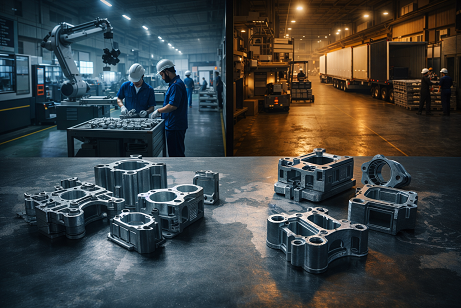
Vietnam Mexico Die Casting: Market Landscape in 2026
The global die casting industry has evolved significantly over the past five years. Nearshoring has strengthened Mexico’s position, while Vietnam has expanded its industrial capacity and export infrastructure.
The Vietnam Mexico die casting discussion now reflects three major shifts:
• Supply chain diversification
• Stabilized freight markets
• Increased tariff awareness
US importers are no longer choosing suppliers based solely on proximity. Instead, they are evaluating full program economics.
Production Cost Structure and Labor Economics
Labor cost differences remain a structural factor in the comparison.
Vietnam continues to maintain lower average manufacturing wages compared to Mexico’s industrial clusters. Although automation reduces labor intensity in modern high-pressure die casting (HPDC) operations, wage differentials still influence:
• Tooling engineering cost
• Mold maintenance
• Secondary machining
• Assembly and finishing
In high-volume aluminum die casting programs, Vietnam typically delivers 5–15 percent lower base production cost.
Mexico’s advantage lies in proximity and faster coordination. However, when calculating total program economics, Vietnam Mexico die casting cost analysis often favors Vietnam for cost-sensitive projects.
Tooling Investment in Vietnam Mexico Die Casting Projects
Tooling is a major capital expense in die casting.
In many 2026 sourcing comparisons:
Vietnam tooling cost is typically 15–25 percent lower than Mexico.
This difference stems from:
• Lower engineering labor rates
• Competitive mold manufacturing clusters
• Integrated EDM and CNC tooling infrastructure
Mexico offers easier physical access for mold trials, which benefits programs requiring frequent engineering iteration.
However, with modern digital simulation and remote project management, Vietnam’s coordination capabilities have significantly improved.
For long-term production programs, tooling amortization often strengthens Vietnam’s cost advantage.
Unit Price Comparison: Aluminum and Zinc Castings
Unit price is central in any sourcing decision.
For automotive-grade aluminum HPDC parts in 2026:
Vietnam: generally lower base cost
Mexico: moderately higher but logistically closer
When machining, powder coating, anodizing, and assembly are integrated, Vietnam’s vertically structured supplier base can reduce internal transfer cost.
This is why Vietnam Mexico die casting analysis frequently shows lower unit economics for stable, high-volume programs.
However, for smaller batches or quick-turn projects, Mexico’s flexibility may offset price differences.
Logistics Cost and Transit Considerations
Logistics is where Mexico holds a visible advantage.
Mexico:
• 2–5 day truck transit
• Lower transit uncertainty
• Reduced inventory buffer
Vietnam:
• 18–28 day ocean transit
• Exposure to freight volatility
• Higher working capital tied in shipping
Yet logistics cost typically represents 3–8 percent of total landed cost for dense metal parts.
In normalized 2026 freight conditions:
Ocean freight from Vietnam remains competitive per kilogram.
Cross-border trucking from Mexico can vary depending on fuel and border congestion.
Therefore, Vietnam Mexico die casting decisions should not rely solely on transit time but on proportional cost impact.
Total Landed Cost Modeling
The correct evaluation method includes:
Unit Price
- Tooling Amortization
- Logistics Cost
- Tariffs
- Inventory Carrying Cost
In structured cost modeling exercises, Vietnam frequently delivers 8–15 percent lower total landed cost in high-volume scenarios.
Mexico becomes more competitive when:
• Lead time sensitivity is high
• JIT delivery is required
• Engineering change frequency is high
Vietnam Mexico die casting comparison therefore depends heavily on program structure.
To compare cost, capability, and sourcing strategy in one place, explore our Vietnam die casting solutions.
Tariffs and Trade Environment
Mexico benefits from USMCA preferences when origin requirements are met.
Vietnam exports are subject to standard MFN duties, typically modest for aluminum die cast components.
However, compared to China sourcing, Vietnam offers competitive tariff positioning and reduced geopolitical risk.
US buyers often evaluate Vietnam Mexico die casting alongside broader diversification strategy rather than in isolation.
Quality Standards and Engineering Capability
Both countries support international quality systems:
• ISO 9001
• IATF 16949
• ASTM compliance
• RoHS standards
Vietnam’s die casting industry has invested heavily in robotic casting cells, CNC machining centers, and CMM inspection systems.
Mexico benefits from strong automotive cluster experience and integration with US Tier suppliers.
In practical terms, supplier selection and audit discipline matter more than country selection.
Strategic Scenario Analysis
Vietnam is typically advantageous when:
• Annual volume exceeds 100,000 units
• Tooling complexity is high
• Cost stability is a priority
• Secondary processing is required
Mexico is advantageous when:
• Production volume is moderate
• Rapid engineering changes occur
• Nearshore logistics flexibility is critical
Rather than viewing Vietnam Mexico die casting as a binary choice, many US companies now adopt hybrid sourcing strategies to balance cost and risk.
Die Casting Cost 2026: China vs Vietnam
For buyers comparing Vietnam vs Mexico die casting options, Die Casting Cost 2026: China vs Vietnam provides valuable insights into labor expenses, material sourcing, tariff impact, and logistics performance. As manufacturing strategies continue to evolve, Vietnam stands out for cost efficiency and export flexibility, while Mexico offers proximity advantages for North American markets.
Final Strategic Outlook for 2026
Vietnam Mexico die casting comparison in 2026 is ultimately about total economic efficiency.
Vietnam offers:
• Lower tooling cost
• Competitive unit pricing
• Integrated manufacturing ecosystem
Mexico offers:
• Shorter transit time
• Simplified logistics
• Regional trade alignment
For cost-sensitive, high-volume production, Vietnam often delivers stronger total landed cost performance. For speed-sensitive or low-volume programs, Mexico may provide strategic advantages.
The optimal decision requires structured cost modeling, supplier audits, and risk assessment.
If you are evaluating offshore versus nearshore die casting for your next project, conduct a comprehensive total cost analysis before investing in tooling.
Contact us today to benchmark your current sourcing structure and determine the most competitive strategy for your business.