
EV die casting Vietnam is becoming a strategic manufacturing solution for global electric vehicle programs that require lightweight aluminum structures, high dimensional accuracy, and scalable production. As EV platforms expand across Europe and North America, OEMs are prioritizing suppliers that combine automotive certification with stable export capacity.
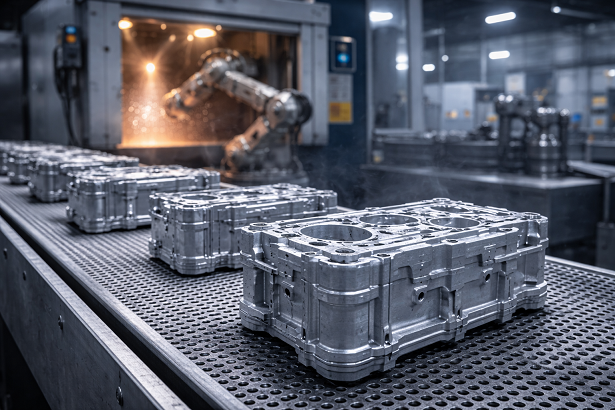
Why EV Die Casting Vietnam Is Gaining Momentum
The global EV market continues to grow rapidly. According to the International Energy Agency, annual EV sales have exceeded 14 million units, pushing manufacturers to optimize vehicle weight and energy efficiency.
EV die casting Vietnam supports this transition by offering:
• Lightweight structural components
• Complex thin-wall geometries
• Efficient thermal management properties
• High-volume production capability
Aluminum remains essential in EV architecture because it reduces mass while maintaining structural strength.
Case Study: Motor Housing Production Program
A European Tier 1 automotive supplier required annual production of over 350,000 aluminum motor housings. The client selected a Vietnamese manufacturer due to:
• Automotive quality systems
• Integrated machining capability
• Competitive total landed cost
• Proven export track record
The project required tight porosity control, strict tolerance management, and consistent surface finishing.
Engineering and Tooling Optimization
Before mass production, engineers conducted mold flow simulation and design-for-manufacturing analysis. The goal was to reduce internal defects and improve yield.
Through engineering refinement, the production team achieved:
• 18% scrap reduction
• 12% cycle time improvement
• Stable casting repeatability
These improvements ensured reliable output throughout multi-year supply contracts.
IATF 16949 Certified Die Casting Vietnam Standards
Automotive EV components must meet rigorous validation requirements. The selected facility operated under IATF 16949 certified die casting Vietnam systems, ensuring:
• PPAP documentation
• Statistical process control
• X-ray inspection for porosity
• Spectrometer alloy verification
• CMM dimensional measurement
By aligning with automotive compliance frameworks, EV die casting Vietnam suppliers can support global OEM audits and long-term platform supply.
Shot Blasting for Surface Performance
Surface integrity plays a critical role in EV component durability. After trimming and CNC machining, shot blasting was applied to improve uniformity and coating readiness.
Shot blasting benefits include:
• Improved adhesion for coatings
• Removal of oxide residues
• Enhanced fatigue resistance
• Consistent cosmetic finish
This finishing stage strengthens reliability in motor and battery applications.
As demand for electric vehicles continues to grow, Aluminum die casting Vietnam suppliers play a key role in delivering lightweight, durable, and high-precision components for modern EV platforms. With advanced manufacturing technologies and strict quality control, these suppliers support efficient production and long-term performance in the global EV industry.
Production Workflow Overview
The manufacturing sequence typically includes:
- Controlled aluminum melting
- High-pressure injection
- Robotic extraction
- Precision CNC machining
- Shot blasting
- Leak testing
- Final inspection and export packaging
Automation reduces variability and ensures consistent performance across high-volume runs.
Mechanical Performance Validation
Independent laboratory testing confirmed:
• Tensile strength exceeding OEM requirement by 8%
• Porosity levels below automotive thresholds
• Thermal conductivity suitable for EV cooling systems
• Tolerance control within ±0.02 mm
These results demonstrate that Vietnam suppliers can meet demanding EV specifications.
Cost and Supply Chain Advantages
Compared to traditional sourcing regions, EV die casting Vietnam offers:
• Competitive labor structure
• Reduced geopolitical trade exposure
• Strong regional aluminum supply
• Efficient port infrastructure
Total landed cost savings ranged between 8–15% without compromising certification or quality standards.
To explore full production capabilities, engineering expertise, and automotive-grade manufacturing solutions, visit our Vietnam die casting page.
Sustainability and ESG Alignment
Modern facilities implement:
• Aluminum scrap recycling
• Energy-efficient furnaces
• Waste heat recovery systems
• RoHS and REACH compliance
Because aluminum is fully recyclable, die casting supports long-term environmental targets in EV manufacturing.
Future Outlook
As EV platforms evolve toward larger structural castings, Vietnam suppliers are investing in:
• Higher-tonnage die casting machines
• Vacuum-assisted casting
• Industry 4.0 production monitoring
EV die casting Vietnam is positioned to support next-generation electric mobility programs with scalable, automotive-grade production systems.
Frequently Asked Questions
What EV components are commonly produced?
Motor housings, inverter casings, battery enclosures, and structural brackets.
Why is IATF 16949 important?
It ensures compliance with global automotive quality management standards.
How does shot blasting improve quality?
It enhances surface finish, durability, and coating adhesion.
Can Vietnam support high annual volumes?
Yes. Facilities can produce hundreds of thousands to millions of units annually.
Is Vietnam cost competitive?
Yes. It offers lower total landed cost while maintaining automotive compliance.
Start Your EV Program with a Certified Supplier
EV die casting Vietnam combines automotive certification, engineering expertise, and scalable production capacity. With integrated machining and precision finishing, your EV components can achieve both performance and cost efficiency.
Contact us today to review drawings, annual volume forecasts, and compliance requirements. Our engineering team will provide a detailed production roadmap tailored to your EV platform.