Tooling is the foundation of any successful die casting project. Mold precision determines part accuracy, cycle time, surface quality, and long-term production stability. When evaluating Die casting mold design Vietnam price, buyers must consider engineering capability, durability, and lifecycle cost — not just the initial quotation.
Understanding Die casting mold design Vietnam price is essential when working with OEM metal casting companies Vietnam to control tooling costs and ensure long-term production efficiency. By optimizing mold structure, material selection, and cavity layout, manufacturers help clients achieve high-quality output while maintaining competitive project budgets.
What Determines Die Casting Mold Design Vietnam Price?
Understanding what affects Die casting mold design Vietnam price helps buyers make informed decisions.
Key cost drivers include:
- Part complexity and geometry
- Mold cavity count
- Tool steel grade
- Expected annual production volume
- Tolerance requirements
- Surface finishing specifications
A lower upfront tooling cost may result in higher long-term production issues. Professional suppliers design molds with:
- Balanced runner systems
- Optimized cooling channels
- Hardened steel selection
- Venting design for porosity control
These engineering decisions improve tool lifespan and reduce scrap rates.
Engineering Process Behind Die Casting Mold Design Vietnam Price
Before issuing a quotation, experienced mold engineers conduct detailed technical analysis.
This typically includes:
- Design for Manufacturability review
- Mold flow simulation
- Gate and runner optimization
- Draft angle verification
- Wall thickness validation
During the Vietnam precision die casting RFQ stage, clear documentation ensures accurate pricing and avoids revision delays.
Providing complete CAD files, projected volumes, and surface requirements enables more precise mold cost estimation.
Vietnam Precision Die Casting RFQ and Tooling Transparency
A structured Vietnam precision die casting RFQ process ensures pricing transparency and engineering alignment.
A professional RFQ response normally contains:
- DFM feedback
- Preliminary mold layout
- Tooling lead time estimate
- Trial shot schedule
- Production scalability plan
Accurate RFQ documentation reduces unexpected cost increases after mold production begins.
Tool Steel Selection and Long-Term Durability
Tool steel directly impacts mold life expectancy.
Common materials include:
- H13 hardened steel
- SKD61
- High-performance imported steels
Higher steel grade increases initial tooling cost but improves durability and reduces maintenance frequency.
When comparing suppliers, consider how steel selection affects the overall Die casting mold design Vietnam price and long-term performance.
Multi-Cavity Strategy and Cost Optimization
Production scalability influences tooling configuration.
Mold design strategies may include:
- Single cavity molds for pilot production
- Expandable multi-cavity structure
- Replaceable insert design
- Modular cavity configuration
This approach balances upfront investment and future expansion capability.
Scalable mold architecture protects long-term ROI
Cooling System Design and Cycle Time Efficiency
Cycle time efficiency depends heavily on cooling channel design.
Advanced mold designers apply:
- Thermal simulation
- Uniform cooling channel routing
- Heat distribution optimization
Effective cooling improves dimensional stability and shortens cycle time, reducing production cost per unit.
Surface Finish Requirements and Trivalent Chromate Compatibility
Surface treatment requirements must be integrated into tooling from the beginning.
For components requiring Trivalent Chromate finishing, mold surface smoothness must meet specific standards to ensure consistent coating quality.
Early alignment between tooling design and finishing specifications prevents rework and additional machining.
Always include finishing details during the RFQ stage.
Mold Fabrication Capability in Vietnam
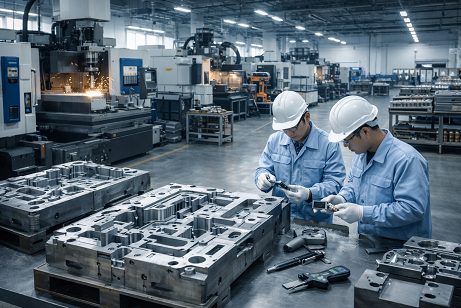
Modern tooling workshops in Vietnam operate advanced equipment such as:
- High-speed CNC machining centers
- EDM systems
- Wire cutting machines
- Precision grinding systems
- Mold testing facilities
The fabrication process generally follows:
- Design approval
- Rough machining
- Heat treatment
- Precision finishing
- Mold assembly
- Trial casting validation
Trial production confirms dimensional accuracy before mass production.
Lead Time and Project Timeline
Tooling lead time varies depending on mold complexity.
Typical timeline:
- 3–5 weeks for moderate molds
- 6–8 weeks for multi-cavity or large molds
Vietnam’s integrated industrial ecosystem reduces internal transfer delays between tooling workshop and die casting facility.
Efficient communication during the Vietnam precision die casting RFQ stage accelerates approval.
Cost Breakdown Structure
Tooling quotation typically includes:
- Engineering design
- Tool steel material
- CNC and EDM machining
- Heat treatment
- Assembly labor
- Trial production
Competitive labor and industrial infrastructure make Die casting mold design Vietnam price attractive compared to Western domestic tooling, while maintaining international quality standards.
Maintenance and Lifecycle Support
Long-term mold performance depends on maintenance.
Reliable suppliers provide:
- Preventive maintenance programs
- Insert replacement services
- Mold refurbishment
- Performance optimization
Regular maintenance reduces downtime and protects tooling investment.
Why Choose Vietnam for Custom Mold Design?
Vietnam offers:
- Competitive tooling cost
- Skilled mold engineers
- Growing industrial infrastructure
- Integrated die casting capability
- Export-ready logistics
Compared to other sourcing regions, Vietnam provides balanced pricing, engineering expertise, and scalable production readiness.
Frequently Asked Questions
1. What affects Die casting mold design Vietnam price the most?
Part complexity, cavity count, and steel grade are the primary factors.
2. How long does mold fabrication take?
Typically between 3 and 8 weeks depending on complexity.
3. Is Vietnam precision die casting RFQ transparent?
Yes. Professional suppliers provide DFM reports and structured pricing.
4. Can molds support Trivalent Chromate finishing?
Yes. Tool surface quality is engineered for coating compatibility.
5. Can tooling scale to mass production?
Yes. Multi-cavity expansion and modular inserts allow production growth.
Request a Tooling Quotation Today
If you are evaluating Die casting mold design Vietnam price for your aluminum or zinc casting project, submit your drawings and volume forecast today.
Our engineering team will review your Vietnam precision die casting RFQ, provide DFM feedback, and deliver transparent tooling pricing with scalable production planning support.